Open a claim to inspect its source, freshness, confidence, counter-evidence, and known unknowns.
Game design document
Player promise
UX flow
Every player-facing state.
Visual direction
World language.
The written Art Bible and visual brief establish the intended style; visual QA is reported separately.
Visual brief
Design language
Art Bible
Art direction
Gallery
See the thing.
The final implementation board appears first, followed by the early visual blueprint and every underlying generated frame with recorded prompts and provenance.
Validation
What machines checked.
Structural checks never claim subjective art quality. Visual acceptance is an independent, hash-bound review.
Source package
Manual Codex gate
Review decisions happen outside this website.
This page only visualizes the current package. Review the implementation board and full-resolution frames in Codex, then record accept, revise, or reject against the exact package hash before any prototype work.
Release color-coded screw-pins in the right order to restore tiny botanical machines that bloom when solved.
State
idea-rejected
Pipeline stage
Stage 0
Advisory score
89 / 100
Evidence integrity
100 / 100
Run
2026-08-screw-puzzle-en-us
Current revision
4
Tags
legacy validation
Updated
2026-08-08
Market evidence claims (0)
No indexed market evidence is attached yet.
Game design document
# Pin & Bloom — Game Design Document v0.1
**Status:** provisional candidate for pretotype
**Updated:** 2026-08-08
**Source opportunity:** opp-calm-fastener-logic
**Production authority:** none until pretotype selection and prototype greenlight
## Product definition
Pin & Bloom is a portrait, flat-2D mobile logic game. The player releases color-coded screw-pins
from layered protective plates in a safe order. Removed pins travel into visible sorting trays.
When the last brace clears, the tiny botanical automaton beneath it unfolds and blooms.
Store-positioning candidate: **Pin & Bloom: Screw Puzzle**
Short promise: **Calm mechanical puzzles that come alive.**
Market evidence supports the broad fastener-puzzle lane. Calm pacing, restoration payoff, fair
economy, and retention are hypotheses.
## Audience and use
- Adults and older children who play logic/sort puzzles in one-to-five-minute breaks
- Players who value readable rules, undo, offline play, and low-pressure sessions
- Not aimed at physics-sandbox or high-speed competition players
- Primary device: phone in portrait; tablet layout scales without changing board topology
## Design pillars
1. **See the rule.** No hidden faces, random physics, or camera search.
2. **Think without pressure.** Normal mode has no timer, lives, or mid-level interruption.
3. **Every solve restores something.** Completion creates a short, memorable living-machine reveal.
4. **Failure teaches.** A jam pauses the board and offers undo/restart; it never sells emergency
recovery as the only path.
## Core loop
1. Read the layered automaton and three visible color trays.
2. Tap a screw-pin to preview what it holds and where it will travel.
3. Tap again to release it.
4. A freed brace slides away when none of its pins remain.
5. Three same-color pins in a tray convert into one decorative seed and clear that tray.
6. If every tray is full with no legal release, the board enters Jammed state.
7. Undo or restart; no life is consumed.
8. Clear every brace and tray.
9. Watch the automaton bloom for two seconds; collect its seed and continue.
Target level time: 60–180 seconds. Target first-session set: five levels in under ten minutes.
## Player verbs
- Inspect: one tap previews pin, held brace, and destination tray.
- Release: second tap confirms.
- Undo: restores the exact previous deterministic state.
- Restart: returns to the certified initial state.
- Pause/resume: persists board state locally.
- Pan: available only when accessibility zoom is enabled; normal boards fit without panning.
No drag precision, camera rotation, pinch dependency, or rapid tapping is required.
## Board model
### Entities
- **Bloom core:** final animated object; never blocks a pin.
- **Brace plate:** flat illustrated shape with a visible z-order and one or more pin sockets.
- **Screw-pin:** color plus redundant engraved symbol; occupies one socket.
- **Tray:** three slots, visible at all times, accepts one configured color family.
- **Seed:** post-match reward token; cosmetic/progression only.
### Deterministic rules
- A pin is legal when its head is not covered by another brace and its destination tray has space.
- Removing a pin changes only its socket, destination tray, and any newly unheld brace.
- A brace releases when all of its pins are removed; movement follows a authored 2D vector.
- Tray matching is deterministic: three equal color-symbol pins clear immediately.
- Jammed means zero legal pin moves while uncleared braces remain.
- Undo restores the exact prior board snapshot, including tray and brace state.
- Every shipped board has a solver certificate produced by the same pure rules module.
- Random generation may choose among certified boards; it never changes a loaded board.
## Difficulty grammar
Difficulty comes from visible dependency depth, branching factor, tray pressure, and symbol count.
| Tier | Layers | Colors | Trays | New demand |
|---|---:|---:|---:|---|
| Seedling | 2–3 | 2 | 3 | learn inspect/release/match |
| Sprout | 3–4 | 3 | 3 | one safe ordering dependency |
| Canopy | 4–5 | 4 | 3 | plan two matches ahead |
| Conservatory | 5–6 | 4–5 | 3 | branching solutions and controlled jams |
No normal board uses a timer. Daily challenge may count moves but cannot remove undo.
## Content structure
- Chapter 1: Paper Conservatory — flower, moth, watering can, songbird, seed clock
- Chapter 2: Sunlit Clockhouse — orrery vine, weather vane, tea automaton, bell flower
- Chapter 3: Cloud Nursery — kite fern, rain beetle, wind blossom, moon greenhouse
- Each chapter: 20 certified boards, five automaton families, four difficulty tiers
- First prototype: one flower automaton, five certified layouts, two-to-four colors
## Progression
- Solved boards add restored automatons to a shelf.
- Seeds unlock palette variants and shelf decorations.
- Chapter access follows completed-board count, not streaks or calendar pressure.
- Optional daily board reuses certified grammar with a move-count medal.
- No energy system, lives, punitive streak loss, or consumable power economy in v0.1.
## Business model hypothesis
INFERRED candidate:
- free first chapter;
- one-time full-game unlock;
- optional cosmetic palette packs;
- optional rewarded preview of a solution step, never required for a solvable board;
- no banner or interstitial during a board.
Willingness to pay, price, conversion, and revenue are UNKNOWN. Pretotype and later store tests must
compare this with a conventional free/ad-supported offer before production lock.
## UX and game states
Canonical states are specified in ux-flow.md. Gameplay must support Ready, Inspecting, Animating,
Jammed, Paused, Solved, and Restoring from persistence. No generated image may introduce a state
absent from that file.
## Art, motion, and audio
- Strict flat 2D orthographic presentation; no isometric or 3D camera
- Light paper-and-enamel botanical atelier; readable mechanical layering
- Released plates glide and settle; no uncontrolled rigid-body physics
- Bloom reveal lasts at most two seconds and can be shortened in accessibility settings
- Audio: soft click, paper slide, ceramic tray note, three-note bloom phrase
- Haptics: light inspect tick, medium release, optional bloom pulse
Art rules live in visual-brief.md and art-bible.md.
## Accessibility
- Every pin color has a unique engraved symbol and tray silhouette.
- Minimum interactive target: 48 CSS pixels in prototype; Unity equivalent scales by Canvas.
- Contrast target: WCAG AA for UI text and essential icons.
- Color-blind preview modes: deuteranopia, protanopia, tritanopia simulation during QA.
- Reduced motion, haptics off, sound sliders, large text, and hold-to-confirm alternative.
- No essential information conveyed by animation, color, sound, or haptics alone.
- Full state recovers after interruption without forcing replay.
## Analytics and validation
Only collect with consent and the minimum event payload:
- tutorial_start, tutorial_complete
- level_start, pin_preview, pin_release, undo, jam, restart, level_complete
- level duration, move count, undo count, jam count, solver-certificate ID
- chapter_paywall_view, unlock_start, unlock_complete
No advertising identifier is required for the core game. Prototype validation focuses on rule
comprehension, next-move predictability, completion, and desire for another board.
## Technical architecture
- Pure BoardState, MoveValidator, TrayMatcher, JamDetector, Solver, and LevelLoader modules
- GameController orchestrates; BoardView and InputHandler remain separate
- Integer IDs and explicit z-order; no physics engine in the rules path
- Level JSON includes braces, sockets, pins, trays, initial z-order, release vectors, and solution
certificate hash
- Save after every committed move using versioned local JSON
- Portrait reference 1080×1920; safe-area aware; minimum supported play width 320 CSS pixels
- Stage 2 implementation is dependency-light HTML/CSS/JavaScript before Unity
## Acceptance tests
1. Solver confirms every bundled board has at least one solution.
2. MoveValidator rejects covered pins and full destinations.
3. Undo restores a byte-equivalent prior rules state.
4. JamDetector reports jam only when no legal moves remain.
5. Save/reload resumes the same board state.
6. Color-blind mode remains playable using symbols alone.
7. A first-time human completes tutorial level without spoken help.
8. A human can predict the consequence of the highlighted next move.
9. Full board can be played at 320-pixel width without overlap or scroll.
10. No timer, life loss, mid-board interstitial, or pay-required recovery exists.
## Kill or revise risks
- Kill if pretotype viewers cannot explain the restoration payoff after five seconds.
- Revise if the botanical theme is liked but the fastener interaction is unclear.
- Kill if the prototype feels like a slower clone after five boards.
- Revise if tray pressure recreates the unfairness the concept promises to remove.
- Kill if certified content requires more authoring effort than the small-team limit permits.
UX flow
# Pin & Bloom — UX Flow and State Matrix v0.1
**Status:** provisional; authoritative for screen inventory
## Primary flow
Launch -> privacy/consent when required -> Home -> Chapter Shelf -> Level Preview -> Gameplay Ready
-> Play -> Solved -> Bloom Reveal -> Result -> next level or shelf.
Recovery flow:
Gameplay -> Jammed -> Undo or Restart.
Gameplay -> Pause -> Settings or Resume.
App interruption -> local save -> Resume Card -> exact prior board state.
Trial flow:
End of free chapter -> Full Game Unlock -> platform purchase -> success returns to Chapter Shelf;
cancel or failure returns without losing progress.
## Screen inventory
| ID | Screen/state | Required content | Exit paths |
|---|---|---|---|
| S01 | Launch | mark, loading state, version fallback | consent or Home |
| S02 | Consent | essential privacy choices, plain language | Home |
| S03 | Home | Continue, Chapters, Daily, Settings | selected destination |
| S04 | Chapter Shelf | restored automata, progress, locked chapter reason | Level Preview, Home |
| S05 | Level Preview | automaton silhouette, difficulty, best moves | Gameplay Ready, back |
| S06 | Gameplay Ready | full board, trays, goal, optional first hint | Playing, Pause |
| S07 | Inspecting | selected pin, held braces, destination preview | confirm, cancel |
| S08 | Animating Move | locked input for short deterministic motion | Playing or Jammed |
| S09 | Jammed | explanation, Undo primary, Restart secondary | Playing, Ready |
| S10 | Pause | Resume, Restart, Settings, Home | selected destination |
| S11 | Solved/Bloom Reveal | restored automaton, skip affordance | Result |
| S12 | Result | moves, undo count, seed, Next, Shelf | next level or shelf |
| S13 | Settings | audio, haptics, symbols, text, motion, privacy | return to caller |
| S14 | Resume Card | saved level and timestamp, Resume, Restart | Gameplay or Preview |
| S15 | Full Unlock | exact included content, price from platform, Restore | purchase/cancel |
| S16 | Purchase Result | success, cancel, failure, retry guidance | Shelf or Unlock |
| S17 | Daily Board | rules, move medal, no timer | Gameplay, Home |
| S18 | Error/Offline | recoverable message, retry, offline-safe path | caller |
## Interaction rules
- Back during play opens Pause; it never abandons silently.
- Overlays dim but do not blur essential board state.
- One primary action per modal.
- All destructive actions require confirmation: Restart, Home while unsaved, reset progress.
- Undo remains on the lower-right one-thumb arc; Pause remains top-left outside the puzzle board.
- Trays remain above the bottom safe area and never move between states.
- Loading, empty, locked, disabled, and error states use icon plus text, not color alone.
- Store price and purchase result are rendered by native/platform UI, not generated raster art.
## Responsive contract
- Portrait is canonical.
- At 320–430 CSS pixels, board scales uniformly; trays remain one row.
- Tablet adds side margins and a wider shelf; it does not rearrange board topology.
- Safe-area insets protect Home/gesture bars and display cutouts.
- Large text may wrap menu labels to two lines; gameplay icons retain 48-pixel targets.
## Visual-generation boundary
GPT Image 2 may illustrate S03, S04, S06, S09, S11, and S12 as style references. Production UI
remains editable in code/Unity. Art references cannot remove accessibility labels, change button
priority, add currencies, or convert the board to 3D/isometric.
Visual brief
# Pin & Bloom — Visual Brief v0.1
**Status:** locked for provisional GPT Image 2 generation
**Model:** gpt-image-2
## Visual thesis
A sunlit pocket conservatory built from cut paper, matte enamel, and restrained brass. The board
reads like a beautifully printed mechanical diagram that becomes alive when solved.
## Pillars
1. **Light, not dark:** warm ivory canvas, daylight, generous breathing room.
2. **Mechanical clarity:** every overlap, pin, socket, and destination is readable at phone size.
3. **Botanical reward:** leaf, petal, moth, seed, and vine forms make restoration emotionally legible.
4. **Premium restraint:** no toy-plastic gloss, casino sparkle, neon bloom, or generic wood planks.
## Locked invariants
- Flat 2D orthographic front view
- Portrait gameplay topology even when a reference board is landscape
- One central layered automaton; three fixed trays below; minimal HUD above
- No perspective depth, isometric angle, 3D render, camera rotation, or hidden back faces
- Braces use visible cut-paper layering; pins are circular with engraved symbols
- UI remains outside the playable object and never covers a legal pin
- Images contain no production text; labels live in Markdown and editable UI
## Palette roles
| Role | Color |
|---|---|
| canvas | warm ivory #F7F0E3 |
| primary ink | slate #253342 |
| mechanism accent | restrained brass #C88A3D |
| success/leaf | green #5FA47A |
| active/coral pin | coral #E87567 |
| information/sky pin | sky #7FB7D8 |
| alternate/lilac pin | lilac #9B8BC4 |
| error/jam | brick #B94E48 |
Color is never the only encoding. Pin families pair circle/triangle/leaf/star engravings with color.
## Shape and material language
- Large rounded botanical silhouettes
- Thin slate outlines with consistent weight
- Shallow printed-paper occlusion shadows only
- Matte enamel pin heads; small restrained brass centers
- Braces look cut and printed, not photorealistic wood or metal
- Trays resemble low ceramic seed dishes with symbol embossing
## Typography and icons
Use a friendly humanist rounded sans direction with open counters and clear numerals. Production
font must be licensed and selected later. Icons use two-pixel-equivalent slate strokes, rounded
caps, and one idea per glyph. No generated text is accepted as final typography.
## Motion and VFX
- Inspect: 120 ms outline breathe, no scale bounce
- Release: quarter-turn pin, vertical lift, curved tray path, 300–450 ms
- Brace clear: authored slide vector with paper shadow collapse
- Match: three quiet ceramic notes and a small seed-ring ripple
- Bloom: 1.2–2.0 s unfolding with two restrained pollen arcs
- Reduced motion: instant state changes plus 150 ms fades
## Anti-references
Avoid dark sci-fi panels, steampunk grime, glossy 3D toy renders, isometric boards, realistic
workbenches, generic wooden screw boards, candy-match UI, casino particles, excessive bevels,
oversaturated neon, dense presentation sheets, fake device frames, watermarks, and added text.
## Master-board strategy
1. Generate gameplay-master.png from the locked invariants.
2. Visually verify topology, dimension, palette, and readability.
3. Generate world-language.png using gameplay-master.png as the style reference.
4. Generate ui-language.png using gameplay-master.png as the style reference.
5. Record every prompt, output, and QA decision in asset-manifest.json.
Art Bible
# Pin & Bloom — Art Bible v0.1
**Status:** provisional candidate; not production locked
**Authority order:** GDD -> UX flow -> this written Bible -> verified reference images
## Core identity
Pin & Bloom is a light editorial 2D puzzle, not a simulated workshop. Its visual signature is a
flat botanical automaton held under patterned paper braces by enamel screw-pins. Solving replaces
clutter with a moment of life.
## Gameplay composition
- Warm ivory full-screen field
- Quiet top HUD: back/pause, level indicator, undo
- Central automaton occupies roughly 58% of screen height
- Three symbol-coded trays sit in the lower play area above the safe zone
- Essential pin heads remain at least one touch target apart
- Overlap shadows explain z-order but never imply uncontrolled depth
- Legal selection adds slate outline and a dotted path to the destination tray
- Illegal selection explains the blocker with a short brace-edge pulse
## World families
### Paper Conservatory
Pressed flowers, moth wings, seed clocks, watering mechanisms. Coral, leaf, sky, and ivory dominate.
### Sunlit Clockhouse
Circular brass diagrams, tea leaves, bells, weather vanes. More slate and brass; brightness remains.
### Cloud Nursery
Wind petals, rain beetles, kite ferns, crescent greenhouse forms. Sky and lilac expand; no dark space.
Every family uses the same pins, trays, outline weights, and UI tokens.
## Interactive object rules
- Pins: circular, matte enamel, high-contrast engraved symbol, small brass center
- Sockets: visible ivory ring with dashed symbol when empty
- Braces: one dominant botanical contour each; no random polygons
- Bloom core: visually quiet until clear; then unfolds, never explodes
- Trays: fixed location, three visible slots, symbol embossed on rim
- Seed reward: small flat emblem; no coin shower
## UI system
- Cards: ivory or white with slate outline and 16–24 px equivalent radius
- Primary action: leaf green fill, slate text when contrast passes
- Secondary action: ivory fill, slate outline
- Warning/jam: brick outline plus knot icon; not a red full-screen flash
- Progress: restored-object silhouettes, not a generic currency bar
- Modal hierarchy follows ux-flow.md; visual art cannot add more currencies or CTAs
## Accessibility and clarity
- Symbols repeat every color meaning.
- Essential outlines remain readable in grayscale.
- Paper shadows are under 12% opacity and never carry information alone.
- UI text targets WCAG AA contrast.
- Reduced motion and large text are designed states, not post-production patches.
## Technical production rules
- Reference canvas: portrait 1080×1920; Art Bible boards may be 1536×1024 landscape.
- Production UI: editable Unity sprites/TMP/layout, not flattened generated screenshots.
- Gameplay pieces: separate sprites with consistent pivots; braces preserve empty pin sockets.
- Nine-slice panels: empty center, uniform border, no baked text.
- File naming: family_subject_state_variant.png.
- Raster concept boards may guide vector/procedural recreation; they are not automatically game-ready.
- Generated source, prompt, references, and QA result remain in asset-manifest.json.
## Do / don't
Do:
- show one unmistakable flat gameplay board;
- use light space and limited color;
- make blocking relationships visible;
- pair color with symbols;
- make restoration the emotional focal point.
Don't:
- turn the board isometric or 3D;
- make a dense slide full of tiny examples;
- bake production labels into images;
- reuse generic wood-plank/screw visuals;
- add characters, currencies, timers, lives, or mechanics absent from the GDD.
## Reference boards
- art-bible/gameplay-master.png — canonical gameplay frame and palette
- art-bible/world-language.png — object families and material/shape language
- art-bible/ui-language.png — editable UI/component direction
Each board is accepted only after visual inspection against the written invariants.
Gallery (3 images)
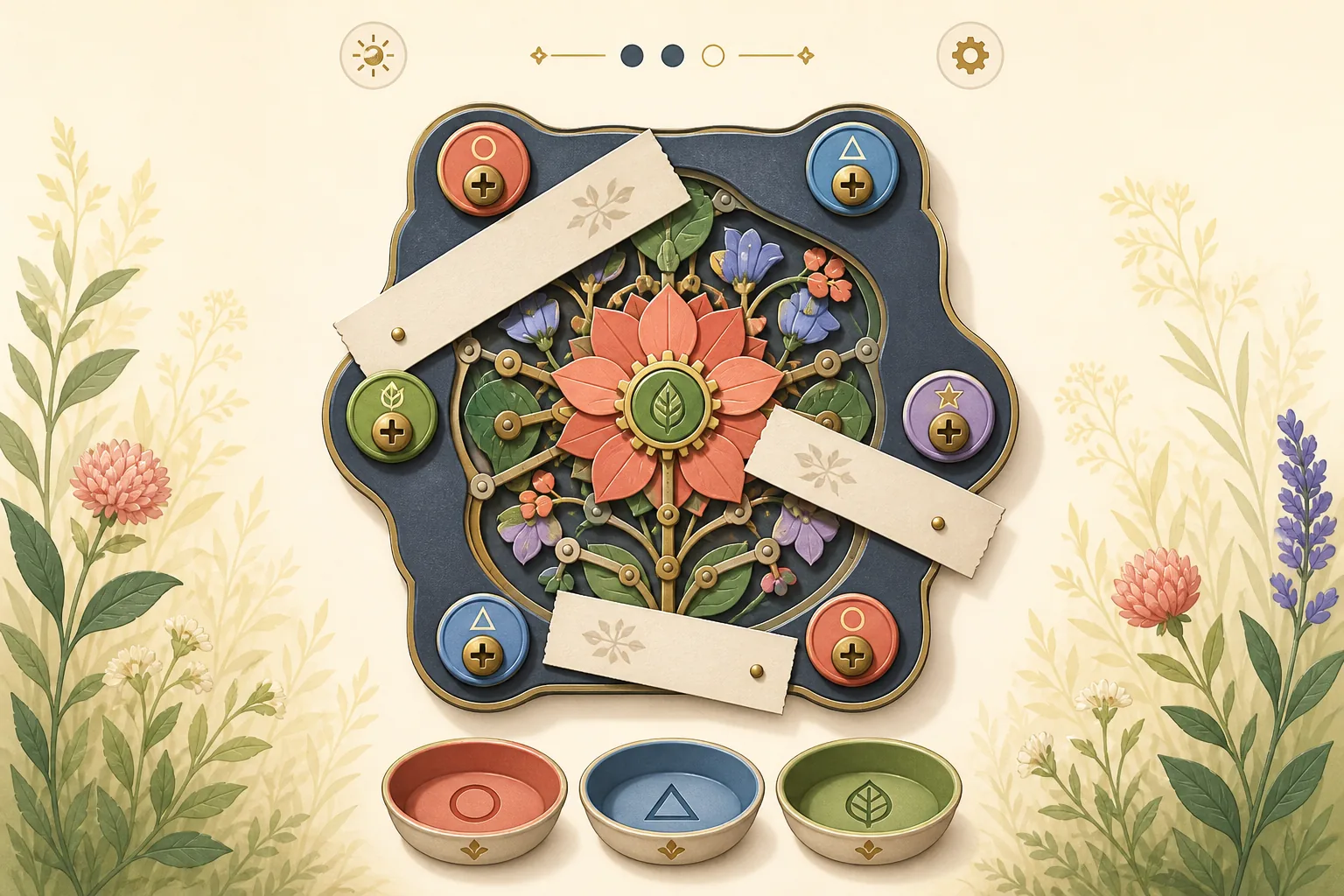
gameplay-master · https://autechsolutions-game-factory.pages.dev/ideas/pin-and-bloom/files/images/art-bible/gameplay-master.webp Generation prompt: Use case: ui-mockup
Asset type: canonical mobile gameplay reference for a 2D puzzle Art Bible
Primary request: show one premium portrait mobile gameplay scene for Pin & Bloom, a calm screw-pin logic puzzle where protective paper braces are removed to reveal a botanical automaton
Scene/backdrop: warm ivory sunlit field with generous breathing room
Subject: one central flat layered flower automaton held by six large enamel screw-pins and three clearly overlapping cut-paper braces; three fixed ceramic symbol-coded trays below the board; minimal quiet HUD above
Style/medium: polished flat 2D editorial game illustration, cut paper plus matte enamel plus restrained brass, crisp vector-like edges
Composition/framing: straight orthographic front view, portrait game topology centered inside a landscape reference canvas, large readable objects, no device frame
Lighting/mood: soft daylight, calm, optimistic, premium, low contrast shadows only for layer order
Color palette: warm ivory, slate ink, leaf green, coral, sky blue, lilac, restrained brass
Constraints: strictly flat 2D; every screw-pin fully visible and touchable; colors paired with engraved circle triangle leaf and star symbols; exactly three trays below; UI outside the board; no text
Avoid: 3D render, isometric angle, perspective camera, realistic workbench, generic wood planks, dark steampunk, cyberpunk, toy plastic gloss, candy UI, timer, lives, currencies, characters, presentation sheet, multiple panels, watermark, extra text
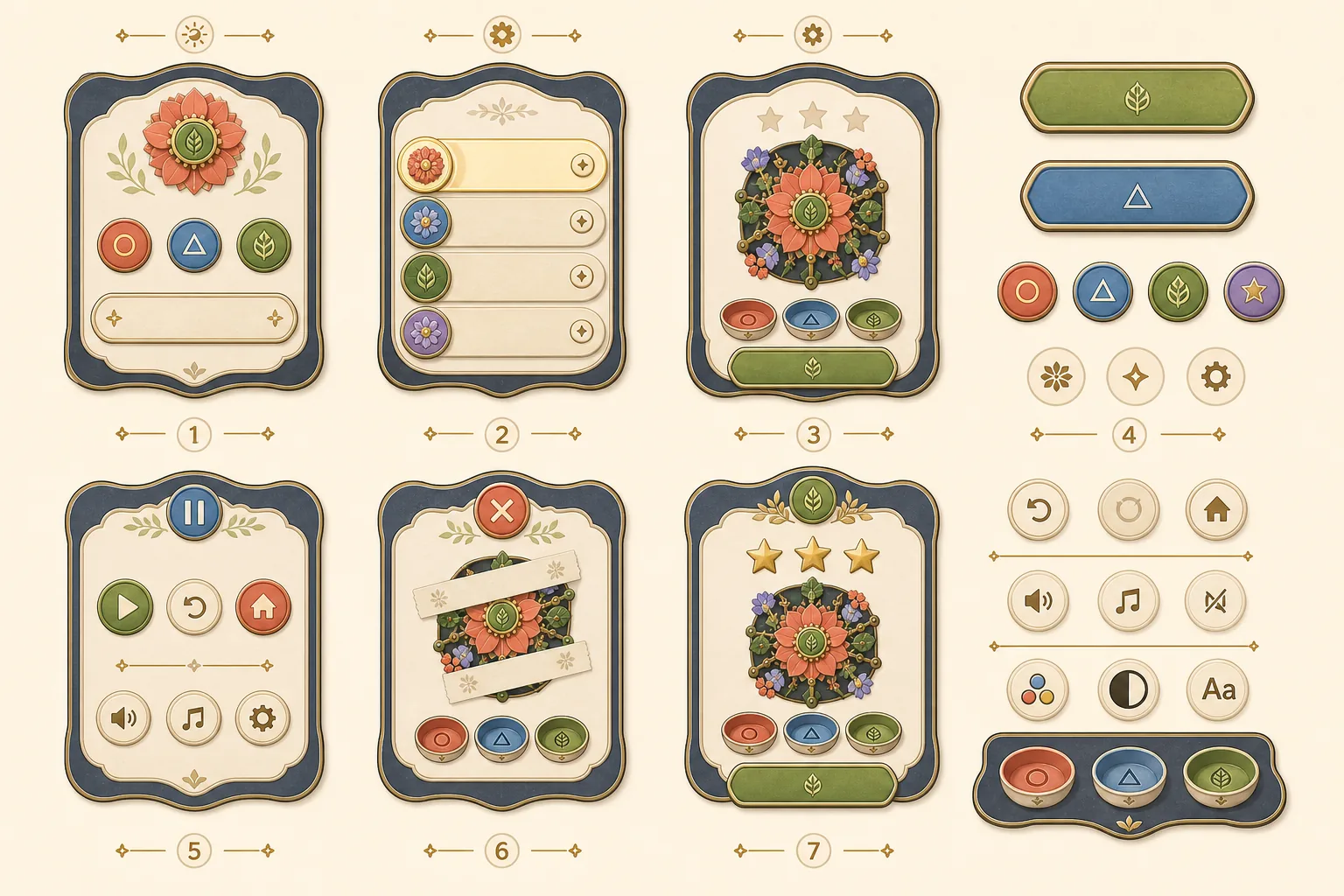
ui-language · https://autechsolutions-game-factory.pages.dev/ideas/pin-and-bloom/files/images/art-bible/ui-language.webp Generation prompt: Use case: ui-mockup
Asset type: editable UI direction reference for a 2D mobile puzzle Art Bible
Primary request: show a small coherent Pin & Bloom UI component system matching the supplied gameplay master
Subject: home card, chapter card, level preview card, primary and secondary buttons, pause modal, jammed modal, result card, undo pause settings and accessibility icons, three-slot tray component
Style/medium: polished flat 2D vector-like mobile UI, cut-paper restraint, matte enamel accents, slate outlines
Composition/framing: light landscape component board with eight large readable groups and generous spacing; components shown straight-on; empty text areas; no device frame
Lighting/mood: calm daylight, friendly, premium
Color palette: match the gameplay master exactly and preserve semantic color roles
Constraints: Image 1 is canonical; flat 2D only; UI must look editable and production-feasible; use symbol placeholders rather than words; show color-plus-symbol accessibility; no baked production copy
Avoid: full 3D screens, isometric panels, dark UI, glassmorphism, neon, casino particles, extra currencies, timer, lives, ad buttons, dense tiny component catalog, fake paragraphs, watermark
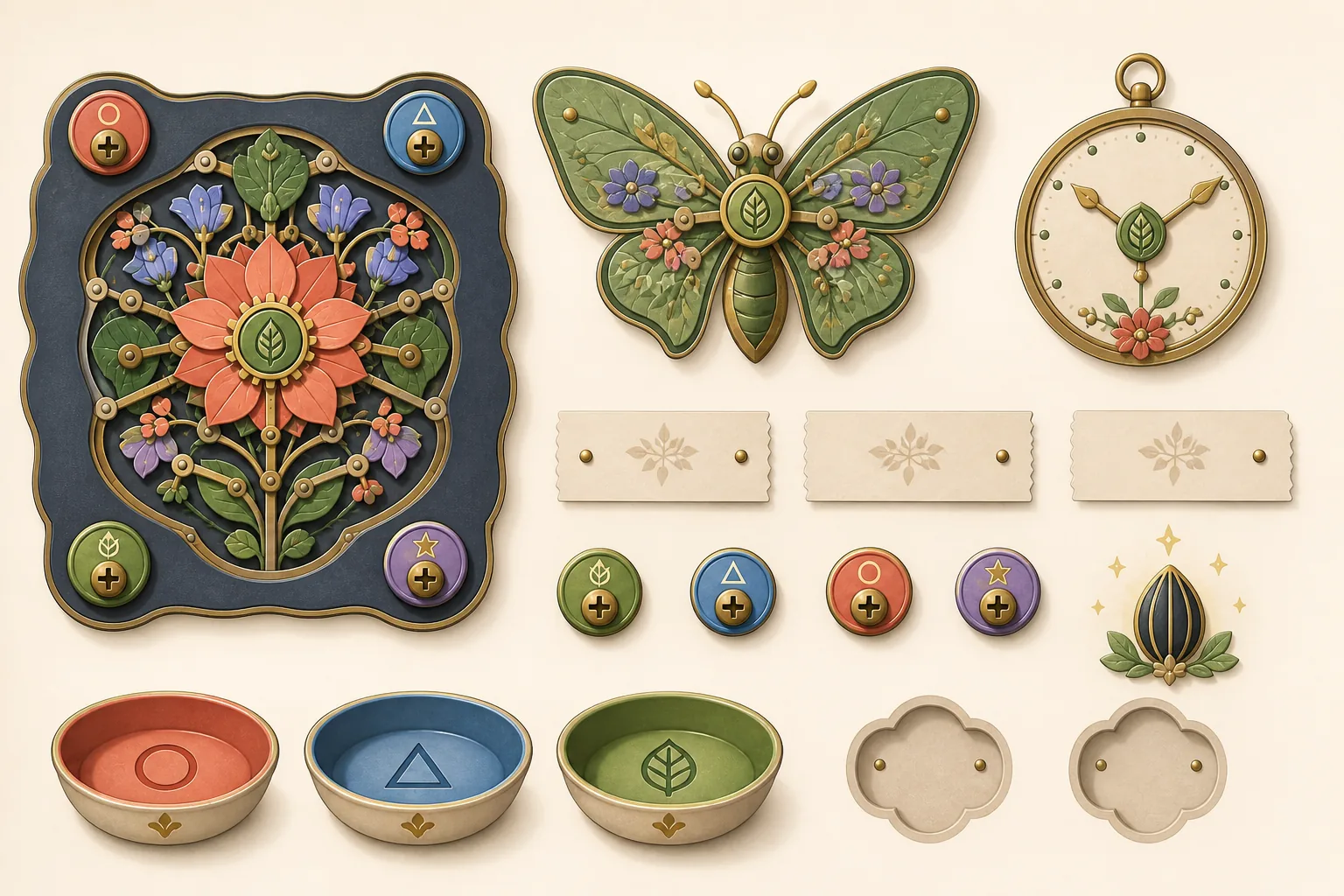
world-language · https://autechsolutions-game-factory.pages.dev/ideas/pin-and-bloom/files/images/art-bible/world-language.webp Generation prompt: Use case: stylized-concept
Asset type: object and environment language board for a 2D mobile puzzle Art Bible
Primary request: a clean curated collection of Pin & Bloom botanical automata and modular game objects that exactly matches the supplied gameplay master
Subject: one restored flower automaton hero, one moth automaton, one seed clock, three cut-paper braces, four enamel symbol pins, three ceramic trays, two empty sockets, one seed reward
Style/medium: polished flat 2D editorial game illustration with crisp vector-like edges, cut paper, matte enamel, restrained brass
Composition/framing: single light landscape board, large separate objects with generous spacing, no overlapping objects, no labels, no fake presentation captions
Lighting/mood: soft daylight, calm and premium
Color palette: match the gameplay master exactly
Constraints: Image 1 is the canonical style and shape reference; preserve its flat orthographic dimension, outline weight, palette roles, material finish, pin symbols, tray construction, and botanical identity; no text
Avoid: new mechanics, 3D, isometric perspective, realistic metal, generic wood, dark background, dense moodboard, tiny thumbnails, character mascot, watermark
Release color-coded screw-pins in the right order to restore tiny botanical machines that bloom when solved.
State
idea-rejected
Stage
0
Score
89
GDD excerpt
Pin & Bloom is a portrait, flat-2D mobile logic game. The player releases color-coded screw-pins from layered protective plates in a safe order. Removed pins travel into visible sorting trays. When the last brace clears, the tiny botanical automaton beneath it unfolds and blooms.
Art excerpt
Pin & Bloom is a light editorial 2D puzzle, not a simulated workshop. Its visual signature is a flat botanical automaton held under patterned paper braces by enamel screw-pins. Solving replaces clutter with a moment of life.
Release color-coded screw-pins in the right order to restore tiny botanical machines that bloom when solved.
State
idea-rejected
Stage
0
Score
89
GDD excerpt
Pin & Bloom is a portrait, flat-2D mobile logic game. The player releases color-coded screw-pins from layered protective plates in a safe order. Removed pins travel into visible sorting trays. When the last brace clears, the tiny botanical automaton beneath it unfolds and blooms.
Art excerpt
Pin & Bloom is a light editorial 2D puzzle, not a simulated workshop. Its visual signature is a flat botanical automaton held under patterned paper braces by enamel screw-pins. Solving replaces clutter with a moment of life.
Release color-coded screw-pins in the right order to restore tiny botanical machines that bloom when solved.
State
idea-rejected
Stage
0
Score
89
GDD excerpt
Pin & Bloom is a portrait, flat-2D mobile logic game. The player releases color-coded screw-pins from layered protective plates in a safe order. Removed pins travel into visible sorting trays. When the last brace clears, the tiny botanical automaton beneath it unfolds and blooms.
Art excerpt
Pin & Bloom is a light editorial 2D puzzle, not a simulated workshop. Its visual signature is a flat botanical automaton held under patterned paper braces by enamel screw-pins. Solving replaces clutter with a moment of life.
Release color-coded screw-pins in the right order to restore tiny botanical machines that bloom when solved.
State
idea-rejected
Stage
0
Score
89
GDD excerpt
Pin & Bloom is a portrait, flat-2D mobile logic game. The player releases color-coded screw-pins from layered protective plates in a safe order. Removed pins travel into visible sorting trays. When the last brace clears, the tiny botanical automaton beneath it unfolds and blooms.
Art excerpt
Pin & Bloom is a light editorial 2D puzzle, not a simulated workshop. Its visual signature is a flat botanical automaton held under patterned paper braces by enamel screw-pins. Solving replaces clutter with a moment of life.
Use case: ui-mockup
Asset type: canonical mobile gameplay reference for a 2D puzzle Art Bible
Primary request: show one premium portrait mobile gameplay scene for Pin & Bloom, a calm screw-pin logic puzzle where protective paper braces are removed to reveal a botanical automaton
Scene/backdrop: warm ivory sunlit field with generous breathing room
Subject: one central flat layered flower automaton held by six large enamel screw-pins and three clearly overlapping cut-paper braces; three fixed ceramic symbol-coded trays below the board; minimal quiet HUD above
Style/medium: polished flat 2D editorial game illustration, cut paper plus matte enamel plus restrained brass, crisp vector-like edges
Composition/framing: straight orthographic front view, portrait game topology centered inside a landscape reference canvas, large readable objects, no device frame
Lighting/mood: soft daylight, calm, optimistic, premium, low contrast shadows only for layer order
Color palette: warm ivory, slate ink, leaf green, coral, sky blue, lilac, restrained brass
Constraints: strictly flat 2D; every screw-pin fully visible and touchable; colors paired with engraved circle triangle leaf and star symbols; exactly three trays below; UI outside the board; no text
Avoid: 3D render, isometric angle, perspective camera, realistic workbench, generic wood planks, dark steampunk, cyberpunk, toy plastic gloss, candy UI, timer, lives, currencies, characters, presentation sheet, multiple panels, watermark, extra text
Use case: ui-mockup
Asset type: editable UI direction reference for a 2D mobile puzzle Art Bible
Primary request: show a small coherent Pin & Bloom UI component system matching the supplied gameplay master
Subject: home card, chapter card, level preview card, primary and secondary buttons, pause modal, jammed modal, result card, undo pause settings and accessibility icons, three-slot tray component
Style/medium: polished flat 2D vector-like mobile UI, cut-paper restraint, matte enamel accents, slate outlines
Composition/framing: light landscape component board with eight large readable groups and generous spacing; components shown straight-on; empty text areas; no device frame
Lighting/mood: calm daylight, friendly, premium
Color palette: match the gameplay master exactly and preserve semantic color roles
Constraints: Image 1 is canonical; flat 2D only; UI must look editable and production-feasible; use symbol placeholders rather than words; show color-plus-symbol accessibility; no baked production copy
Avoid: full 3D screens, isometric panels, dark UI, glassmorphism, neon, casino particles, extra currencies, timer, lives, ad buttons, dense tiny component catalog, fake paragraphs, watermark
Use case: stylized-concept
Asset type: object and environment language board for a 2D mobile puzzle Art Bible
Primary request: a clean curated collection of Pin & Bloom botanical automata and modular game objects that exactly matches the supplied gameplay master
Subject: one restored flower automaton hero, one moth automaton, one seed clock, three cut-paper braces, four enamel symbol pins, three ceramic trays, two empty sockets, one seed reward
Style/medium: polished flat 2D editorial game illustration with crisp vector-like edges, cut paper, matte enamel, restrained brass
Composition/framing: single light landscape board, large separate objects with generous spacing, no overlapping objects, no labels, no fake presentation captions
Lighting/mood: soft daylight, calm and premium
Color palette: match the gameplay master exactly
Constraints: Image 1 is the canonical style and shape reference; preserve its flat orthographic dimension, outline weight, palette roles, material finish, pin symbols, tray construction, and botanical identity; no text
Avoid: new mechanics, 3D, isometric perspective, realistic metal, generic wood, dark background, dense moodboard, tiny thumbnails, character mascot, watermark
{
  "version": 1,
  "status": "verified-provisional",
  "model": "gpt-image-2",
  "authority": [
    "gdd.md",
    "ux-flow.md",
    "visual-brief.md",
    "art-bible.md"
  ],
  "assets": [
    {
      "id": "gameplay-master",
      "role": "canonical gameplay and palette reference",
      "prompt": "image-prompts/gameplay-master.txt",
      "output": "art-bible/gameplay-master.png",
      "references": [],
      "qa": "passed: strict front view, six visible pins, three trays, no text or extra mechanics; low-relief material rendering is acceptable as reference, not production geometry"
    },
    {
      "id": "world-language",
      "role": "object, material, and world-family reference",
      "prompt": "image-prompts/world-language.txt",
      "output": "art-bible/world-language.png",
      "references": [
        "art-bible/gameplay-master.png"
      ],
      "qa": "passed: palette, pin symbols, trays, botanical identity, and straight-on object language remain consistent with gameplay master"
    },
    {
      "id": "ui-language",
      "role": "editable UI and component direction",
      "prompt": "image-prompts/ui-language.txt",
      "output": "art-bible/ui-language.png",
      "references": [
        "art-bible/gameplay-master.png"
      ],
      "qa": "passed with caveat: coherent UI language and no forbidden economy; generated index numerals are non-authoritative and must not enter production UI"
    }
  ]
}