Open a claim to inspect its source, freshness, confidence, counter-evidence, and known unknowns.
Game design document
Player promise
UX flow
Every player-facing state.
Visual direction
World language.
The written Art Bible and visual brief establish the intended style; visual QA is reported separately.
Visual brief
Design language
Art Bible
Art direction
Gallery
See the thing.
The final implementation board appears first, followed by the early visual blueprint and every underlying generated frame with recorded prompts and provenance.
Validation
What machines checked.
Structural checks never claim subjective art quality. Visual acceptance is an independent, hash-bound review.
Source package
Manual Codex gate
Review decisions happen outside this website.
This page only visualizes the current package. Review the implementation board and full-resolution frames in Codex, then record accept, revise, or reject against the exact package hash before any prototype work.
# Pulsepath GDD v0.1
## Product promise
Drag the route. Read the beat. Release the pulse. Route a signal through phase gates that only open on
their matching arrival beat.
## Core rules
1. The board is a deterministic orthogonal grid with a source, receiver, open cells, walls, and phase gates.
2. A route is a non-repeating chain of adjacent open cells beginning at the source.
3. Each new cell advances the visible beat by one.
4. Cyan gates accept even arrival beats; amber gates accept odd arrival beats.
5. Releasing resolves the route in order. A gate mismatch fails at that gate and leaves the route editable.
6. Reaching the receiver with every gate accepted wins the board.
## Content
The prototype contains 50 reachable boards from four deterministic templates. The production target
is 120 boards across six gate and obstacle families, with no procedural difficulty claims until a
solver verifies each board.
## UX and safety
Mobile-first portrait, one-thumb drag, no document scroll, high-contrast gate colors plus parity
labels, mouse/click and keyboard fallbacks for web/desktop, reduced-motion-safe CSS, and a
replayable FTUE. No ads, accounts, or network are required by the core loop.
UX flow
# Pulsepath UX flow
1. **Title shell** — Play, level selector, How to Play, muted procedural sound toggle.
2. **FTUE** — three steps: goal, drag-and-release-to-route with click/keyboard fallback, then gate success/failure feedback.
3. **Board** — source, receiver, walls, phase gates, route, beat counter, Clear, Hint; release commits the pulse.
4. **Failure** — route remains visible; the failed gate is named and the player can revise.
5. **Success** — pulse trail completes, board number advances, Replay and Next appear.
6. **Level selector** — 50 deterministic buttons with completion state.
First-run completion is persisted only after the first valid route extension, never merely by opening
or dismissing the FTUE.
Visual brief
# Pulsepath visual brief
Use a dark instrument-panel field with a warm receiver and cool signal. The board should read as a
physical grid, but all mechanic information is code-native: wall cells, route line, beat badges, and
gate parity labels. Cyan means even, amber means odd; the label remains visible so color is not the
only cue. Motion is short, reversible, and subordinate to the route decision.
Art Bible
# Pulsepath Art Bible v0.1
- Palette roles: midnight `#0B1020`, panel `#151D33`, cyan `#5AE6D2`, amber `#FFC857`, coral `#FF7B7B`, paper `#F3F7FA`.
- Shape language: rounded squares, ring gates, 4px signal strokes, compact monospaced labels.
- Camera: top-down portrait board, no perspective, no character layer.
- Motion: signal travels in discrete beats; gate pulse is a ring expansion; failure uses a brief coral flash.
- Negative references: no pipes that rotate independently, no city map, no block stack, no copied store iconography.
- Reference image: `art-bible/pulsepath-master.png`.
Gallery (1 images)
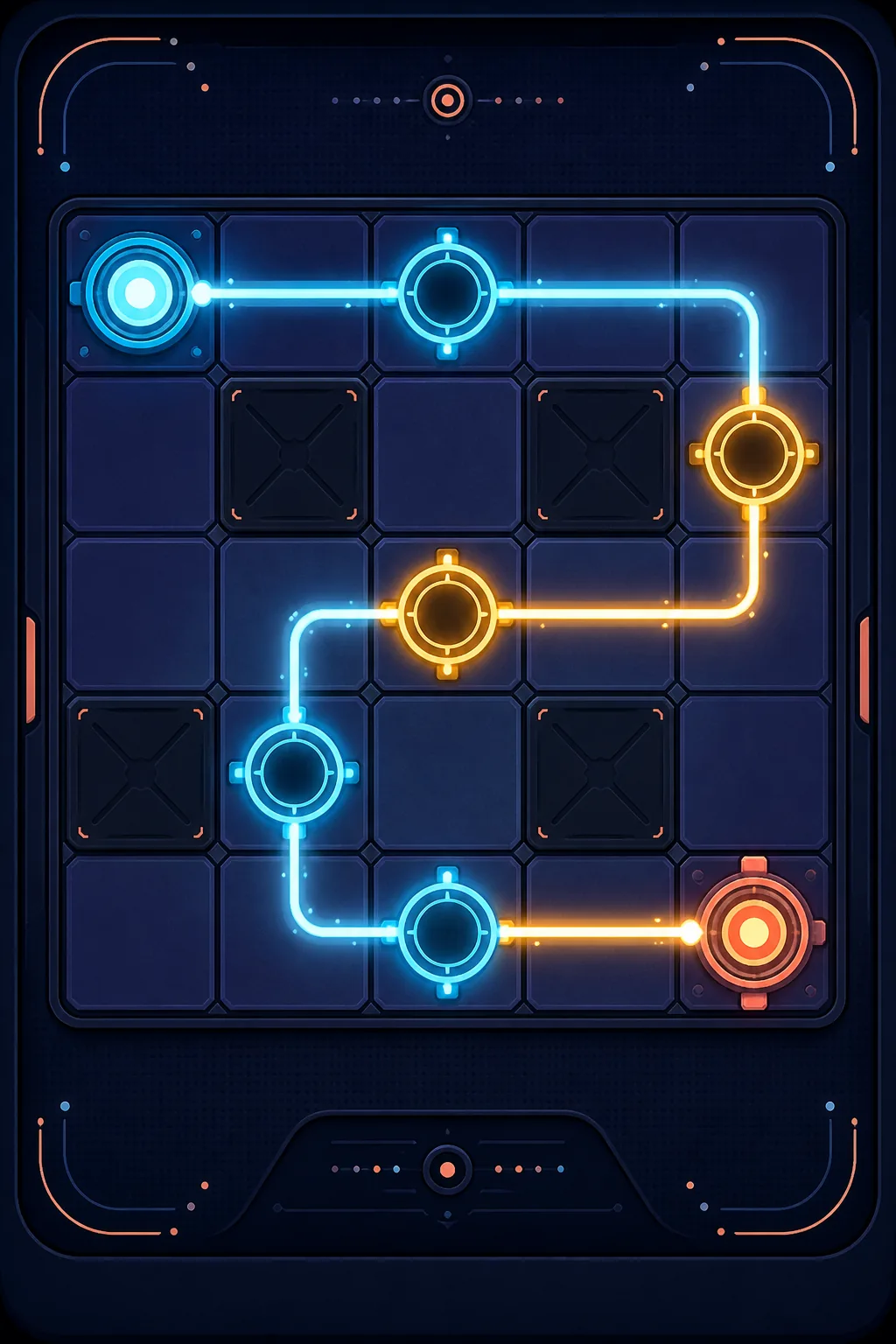
pulsepath-master · https://autechsolutions-game-factory.pages.dev/ideas/pulsepath/files/images/art-bible/pulsepath-master.webp Generation prompt: Use case: stylized-concept. Asset type: mobile puzzle game visual reference. Create a top-down portrait puzzle board where a luminous signal route crosses a compact grid and passes alternating cyan and amber phase gates. Deep indigo instrument panel, matte enamel, crisp geometric edges, no text, no characters, no logos, no watermark, original composition, readable at thumbnail size.
Draw a route through a changing grid, then commit the signal and watch each phase gate accept or reject the path on its arrival beat.
State
prototype-live
Stage
2
Score
72
GDD excerpt
Drag the route. Read the beat. Release the pulse. Route a signal through phase gates that only open on their matching arrival beat.
Art excerpt
- Palette roles: midnight #0B1020, panel #151D33, cyan #5AE6D2, amber #FFC857, coral #FF7B7B, paper #F3F7FA. - Shape language: rounded squares, ring gates, 4px signal strokes, compact monospaced labels. - Camera: top-down portrait board, no perspective, no character layer. - Motion: signal travels in discrete beats; gate pulse is a ring expansion; failure uses a brief coral flash. - Negative references: no pipes t...
Draw a route through a changing grid, then commit the signal and watch each phase gate accept or reject the path on its arrival beat.
State
prototype-live
Stage
2
Score
72
GDD excerpt
Drag the route. Read the beat. Release the pulse. Route a signal through phase gates that only open on their matching arrival beat.
Art excerpt
- Palette roles: midnight #0B1020, panel #151D33, cyan #5AE6D2, amber #FFC857, coral #FF7B7B, paper #F3F7FA. - Shape language: rounded squares, ring gates, 4px signal strokes, compact monospaced labels. - Camera: top-down portrait board, no perspective, no character layer. - Motion: signal travels in discrete beats; gate pulse is a ring expansion; failure uses a brief coral flash. - Negative references: no pipes t...
Draw a route through a changing grid, then commit the signal and watch each phase gate accept or reject the path on its arrival beat.
State
prototype-live
Stage
2
Score
72
GDD excerpt
Drag the route. Read the beat. Release the pulse. Route a signal through phase gates that only open on their matching arrival beat.
Art excerpt
- Palette roles: midnight #0B1020, panel #151D33, cyan #5AE6D2, amber #FFC857, coral #FF7B7B, paper #F3F7FA. - Shape language: rounded squares, ring gates, 4px signal strokes, compact monospaced labels. - Camera: top-down portrait board, no perspective, no character layer. - Motion: signal travels in discrete beats; gate pulse is a ring expansion; failure uses a brief coral flash. - Negative references: no pipes t...
Draw a route through a changing grid, then commit the signal and watch each phase gate accept or reject the path on its arrival beat.
State
prototype-live
Stage
2
Score
72
GDD excerpt
Drag the route. Read the beat. Release the pulse. Route a signal through phase gates that only open on their matching arrival beat.
Art excerpt
- Palette roles: midnight #0B1020, panel #151D33, cyan #5AE6D2, amber #FFC857, coral #FF7B7B, paper #F3F7FA. - Shape language: rounded squares, ring gates, 4px signal strokes, compact monospaced labels. - Camera: top-down portrait board, no perspective, no character layer. - Motion: signal travels in discrete beats; gate pulse is a ring expansion; failure uses a brief coral flash. - Negative references: no pipes t…
Use case: stylized-concept. Asset type: mobile puzzle game visual reference. Create a top-down portrait puzzle board where a luminous signal route crosses a compact grid and passes alternating cyan and amber phase gates. Deep indigo instrument panel, matte enamel, crisp geometric edges, no text, no characters, no logos, no watermark, original composition, readable at thumbnail size.